
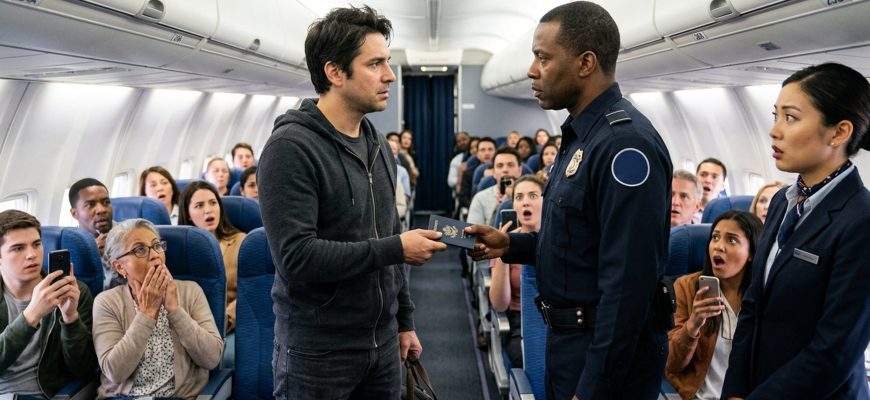
He settled into his first-class seat—then everything shifted when he calmly stated, “This airline belongs to me.”
Flight A921 was scheduled to depart from Hartsfield-Jackson Atlanta International Airport on a mild spring afternoon in 2025, shortly after 2:00 p.m.
The terminal pulsed with the familiar rhythm of air travel—rollers clattered across polished floors, overlapping announcements dissolved into the steady hum of conversation, and travelers hunched over their phones hunting for open outlets. On the surface, it looked like any ordinary travel day.
At least, that was the impression.
Amid the moving crowd stood a man who drew little attention.
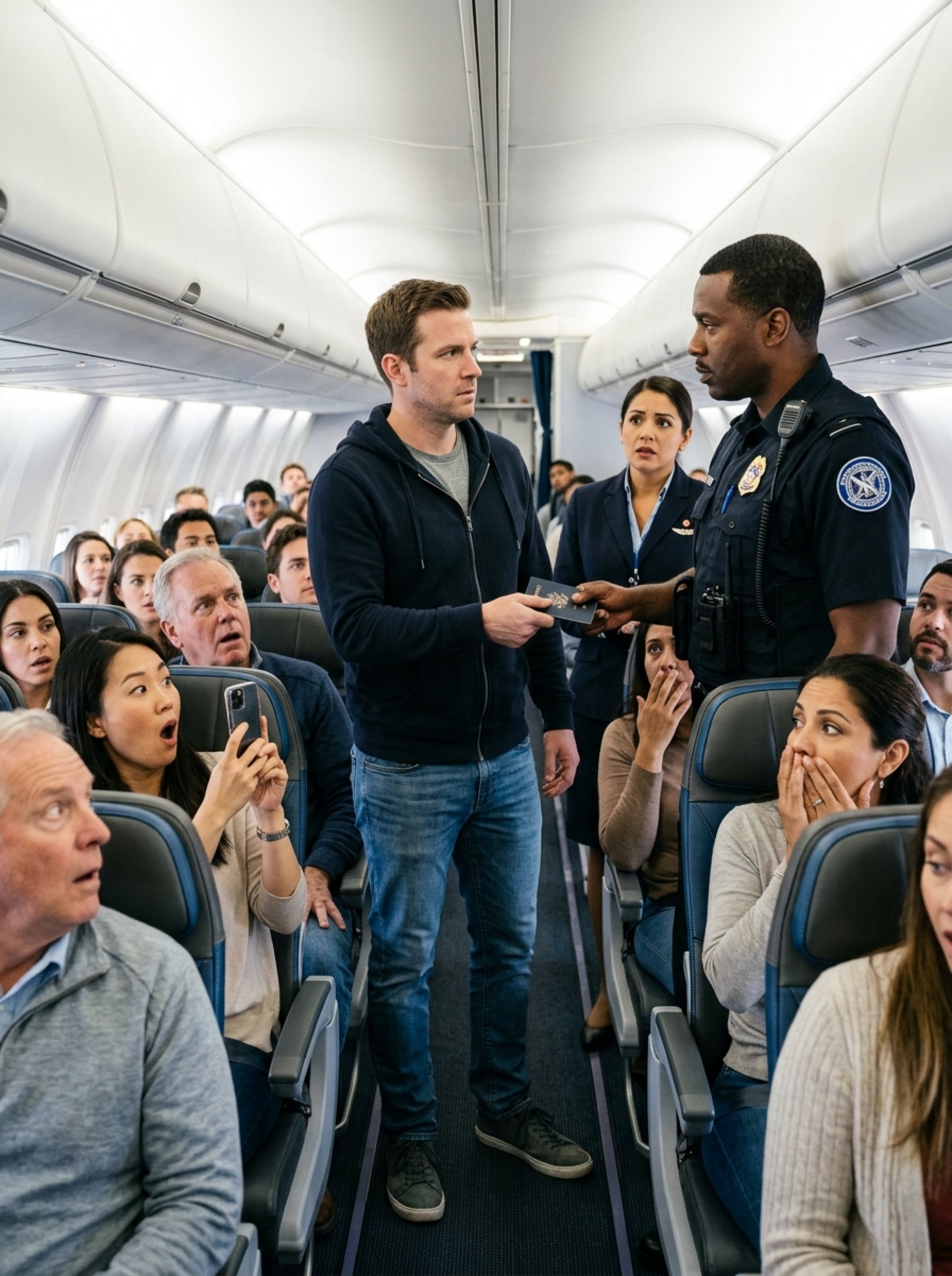
Michael wore a simple charcoal-gray hoodie, faded jeans, and white sneakers that were clean but clearly well worn. Nothing about him suggested privilege or power. There was no tailored blazer, no designer watch, no visible symbol of wealth. Just a composed demeanor—and a slim black leather briefcase embossed discreetly with the initials “M.C.”
In one hand, he carried a cup of plain black coffee.
In the other, a boarding pass that quietly signaled authority:
Seat 1A.
Front row. First class.
Whenever he flew with this airline, that seat was always reserved for him.
Because Michael was far more than a typical passenger.
He was the company’s founder, its CEO, and majority shareholder—holding 68 percent of the organization.
Yet that afternoon, he wasn’t boarding as an executive.
He stepped onto the aircraft as an anonymous traveler.
And not a single person seated nearby had any idea who he truly was.
A quiet experiment
Michael boarded early, offering the crew a polite nod before slipping into seat 1A without ceremony. He placed his coffee on the armrest, unfolded a newspaper, and exhaled slowly.
In less than two hours, the plane would touch down in New York, where a closed-door emergency board meeting awaited him—one that had the potential to reshape the airline’s internal operations in profound ways.
—one that could redefine how the airline functioned behind the scenes.
For several months, Michael had quietly authorized an internal review. The focus wasn’t profits or fuel costs, but something less visible: customer complaints, patterns in passenger treatment, subtle reports about crew conduct. The spreadsheets revealed trends, yet numbers alone failed to capture tone, assumption, or those fleeting instances of quiet disrespect that rarely made it into official reports.
What he saw in the data unsettled him.
Charts and percentages could highlight irregularities, but they could not convey the sharp edge in a voice, the dismissive glance, or the quiet presumption about who belonged where.
So he chose to witness it firsthand.
No advance notice.
No executive escort.
No title attached to his name.
Only observation.
What he hadn’t anticipated was how quickly the “experiment” would begin.
A woman halted beside his seat, looked him over briefly, and said with clipped certainty, “Excuse me, you’re sitting in the wrong place.”
Before he could respond, her voice hardened.
“You’re in my seat.”
The words came from just behind him—precise and commanding.
A manicured hand clamped onto his shoulder and yanked. The sudden force pitched him forward; his coffee sloshed over the rim of the cup, splattering across his newspaper and soaking through his jeans.
“I’m sorry?” Michael rose automatically, more startled than angry.
Standing before him was a woman in her forties, dressed in an immaculate cream designer suit. Her hair was sculpted into place, diamonds circling her wrist and catching the cabin light. Even her perfume seemed to announce authority seconds before she spoke.
Without waiting for acknowledgment, she lowered herself into seat 1A.
“There,” she declared briskly, smoothing the front of her jacket. “Problem solved.”
Michael stared—not because of the seat itself, but because of the effortless entitlement with which she had claimed it.
“I believe that seat is assigned to me,” he replied evenly.
Her gaze traveled from his shoes to his face, lingering with open disapproval.
“First class is up here,” she said slowly, as if explaining something obvious. “Coach is in the back.”
Around them, passengers began pretending not to watch. A few phones subtly lifted. The atmosphere shifted, tightening like air before a storm.
A flight attendant hurried over—Ashley, her professional smile firmly in place.
“Is there an issue here?” she asked, instinctively resting a reassuring hand on the woman’s arm.
“Yes,” the woman answered at once.
“Yes,” the woman declared loudly. “This man is sitting in my seat.”
Michael didn’t raise his voice. He simply extended his boarding pass toward them.
“Seat 1A,” he said evenly. “That’s assigned to me.”
Ashley gave the card the briefest glance—barely long enough to register anything.
“Sir,” she replied, tension creeping into her tone, “your seat is in the rear cabin.”
“I’d appreciate it if you actually read it,” Michael answered, meeting her eyes without flinching.
The woman let out a sharp, dismissive laugh. “Let’s be honest,” she scoffed. “Do you really think someone dressed like that belongs up here?”
Three rows back, a teenager tapped the “Go Live” button on his phone.
Tension Before Takeoff
A senior flight supervisor strode down the aisle—Brian. He assumed control instantly, not bothering to ask questions.
“You’re delaying this flight,” Brian snapped at Michael. “Go to your assigned seat. Now.”
“You haven’t even checked my boarding pass,” Michael replied calmly.
Brian waved off the comment. “If you refuse to comply, airport security will escort you off this aircraft.”
On the livestream, the viewer count surged—hundreds turning into thousands within seconds.
Comments flooded the screen:
Why won’t they read his ticket?
This is blatant racism.
It’s 2025—how is this still happening?
Michael remained composed—not because the moment didn’t sting, but because it confirmed every concern he had carried with him.
The Turning Point
Security arrived.
An officer named Jason stepped forward and took the boarding pass from Michael. Unlike the others, he examined it carefully.
“Seat 1A,” Jason announced clearly.
The cabin fell into stunned silence.
Brian frowned. “That can’t be right,” he muttered. “Just look at him.”
Those three words would later echo across headlines, legal documents, and corporate training sessions.
Without another word, Michael unlocked his phone and opened a secure application—one unavailable to the general public.
The airline’s logo filled the display.
Then new text appeared on the screen:
Michael – Chief Executive Officer
Ownership Stake: 68%
Employee ID: 000001
Access Level: Unlimited
He turned the screen so the uniformed officer could read it clearly.
Then he angled it toward Brian.
Finally, he held it where the woman—frozen in her seat—could see every line without obstruction.
“I own this airline,” Michael said quietly.
The words didn’t rise above a calm tone, yet they detonated like a shockwave.
Color drained from the woman’s face.
“That’s… that’s not possible,” she breathed.
Michael met her stare without blinking. “From a technical standpoint,” he replied evenly, “every seat on this aircraft belongs to me.”
Online, the reaction was instantaneous. The livestream exploded with comments and shares. Within minutes, more than 120,000 viewers had tuned in.
Michael placed several calls, activating the speaker so there would be no ambiguity.
First—Legal.
Then—Human Resources.
After that—Public Relations.
Immediate suspensions were issued. Terminations received authorization. A press conference was scheduled before sunset.
When the calls ended, he faced the woman again. By then, her name was already trending across social media:
Jennifer Harper – Senior Director of Brand Strategy
Public advocate for diversity and inclusion.
The irony was merciless.
“You speak publicly about equality,” Michael said, his voice controlled but unyielding. “Yet you couldn’t offer basic respect to the person sitting in front of you.”
Tears spilled down her cheeks. “I didn’t mean for this to happen,” she whispered.
“Intent doesn’t erase impact,” Michael answered.
—
Aftermath and Reform
The flight eventually departed—with an entirely new crew.
At last, Michael settled into seat 1A.
Within days, the airline announced sweeping reforms:
Mandatory anti-bias education for all employees.
Body cameras for cabin staff.
Stronger passenger protection procedures.
A $50 million annual initiative dedicated to equity programs.
The video surpassed 15 million views.
Other carriers began implementing similar measures.
What started as a confrontation became a turning point.
—
One Year Later
Twelve months afterward, Michael boarded the same route again.
Same aircraft model.
Same seat—1A.
But the atmosphere felt transformed.
Passengers were greeted with uniform courtesy and dignity, no matter their appearance or background.
He allowed himself a small, private smile.
Because respect, he knew, has never been about status or clothing labels.
It’s about choice.
And about having the courage to say—
“Read the ticket.”