
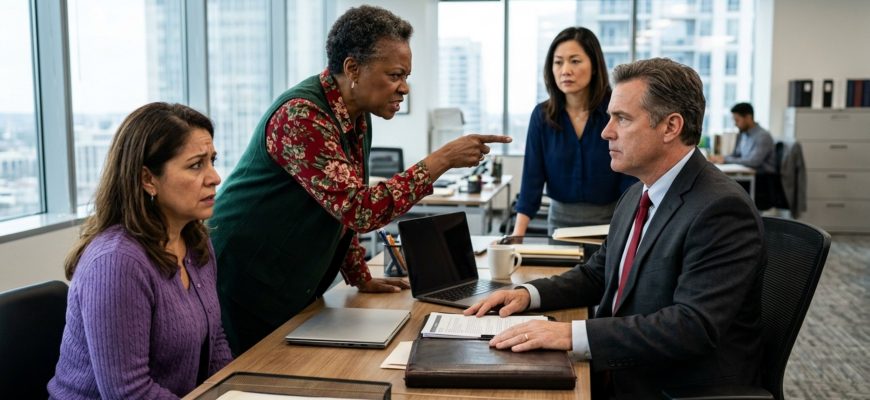
“Margaret, I’m going to have to ask you to step outside,” the notary said, snapping the folder shut. He looked at his client’s mother as if she should already be on the other side of the door. “Michael’s will cannot be read in your presence. Only his wife is permitted.”
Margaret froze, her mouth hanging open in disbelief. Her daughter Emily jerked forward as though to argue, but the older woman reacted first.
“What do you mean I can’t stay? I’m his mother! I have every right to know what my son—”
“You do not,” the notary cut in calmly, turning the document toward himself. “Please leave the office. Immediately.”
Laura sat with her hands folded tightly in her lap. She stared past everyone at the window, where a dull April sky pressed against the glass. Michael had died six months earlier—collapsed in the middle of the bakery floor, surrounded by the smell of sugar and vanilla. A blood clot, the doctors had said. Instant. She still hadn’t fully absorbed that he was gone for good. And yet here she was, dragged into this office because her mother-in-law and sister-in-law couldn’t bear to wait another day.

Margaret stormed out, slamming the door hard enough to rattle the frame.
The notary broke the seal on the envelope.
“Rachel Kovaleva. Do you know that name?”
Laura said nothing at first. It meant absolutely nothing to her. The notary watched her closely, as if measuring every flicker of her expression.
“No,” she answered at last.
“Your husband amended his will a year ago. Eighty percent of his company and all liquid assets are to go to Rachel Kovaleva. In addition, two minors—Ethan and Lily—are listed as beneficiaries. You retain the apartment and the lake house. Your mother-in-law and sister-in-law receive old shares that, frankly, generate almost no income.”
The words reached her ears, but their meaning refused to settle. Rachel. Two children. She tried to force the pieces together in her mind, but they wouldn’t align. Michael had never stayed out late. He never guarded his phone. He had never once lied to her face.
“Give me the address,” she said quietly.
The notary handed her a slip of paper. A residential neighborhood outside the city limits. Laura folded it carefully and slipped it into the pocket of her coat.
The moment she stepped into the hallway, Margaret and Emily descended on her like starving birds.
“Well? What did it say? How much are we getting?”
Laura walked past them without speaking. Emily grabbed her shoulder and spun her around.
“Are you deaf? Answer us!”
“Almost nothing,” Laura replied evenly, meeting her gaze. “You were left almost nothing.”
They showed up at her apartment the very next day. Margaret positioned herself on the couch like a judge about to deliver a sentence. Emily hovered beside her. At the table sat a rumpled man in a wrinkled jacket who introduced himself as their attorney.
“We’re contesting the will,” Margaret announced. “Michael wasn’t in his right mind. Someone manipulated him. Some tramp drained his money, and now we’re expected to sit quietly?”
Laura stood by the window, silent.
“I’ve already found witnesses,” Emily said, waving a sheet of paper. “The neighbor will testify that my brother was acting strangely in the last few months. And a former baker is willing to say Michael behaved erratically, yelled at staff.”
“For a fee, I assume,” Laura said, turning from the glass.
“What difference does that make?” Emily lifted her chin defiantly. “All that matters is convincing the court the will is invalid. You’re his wife, Laura. You’re obligated to defend his memory!”
Laura shifted her eyes to her mother-in-law. Margaret sat there rigidly, lips pressed into a thin line, her face like carved stone, waiting for Laura to answer.