
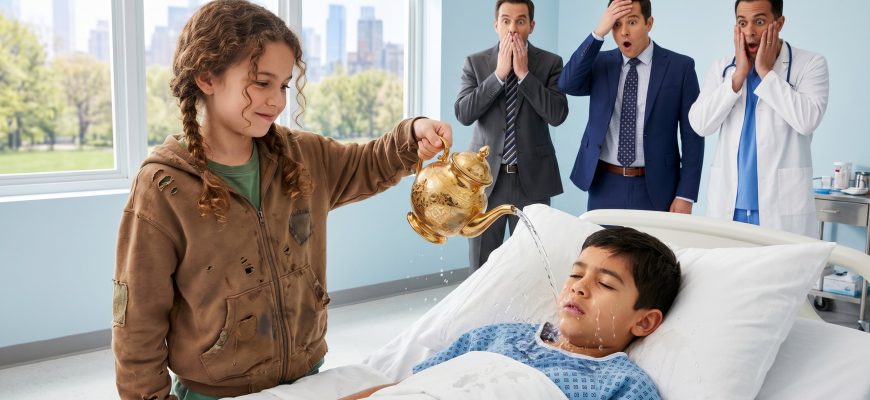
Doctors gave the billionaire’s son five days to live—then a poor, strange little girl did something no one could explain…
David was told his little boy had, at most, five days left.
Maybe a week, if mercy happened to be on their side.
In the hallway of St. Gabriel Hospital in downtown Dallas, the sharp odor of disinfectant mixed with the bitter smell of scorched coffee. Under the fluorescent lights, everything appeared harsher and colder than it really was—the walls, the faces passing by, even David’s trembling hands.
For three weeks, David had practically lived in a fake-leather chair outside the pediatric intensive care unit. His suit was wrinkled. Dark stubble covered his jaw. His phone was almost always pressed to his ear, as if wealth, influence, or one more urgent call could still force the world to change its mind.
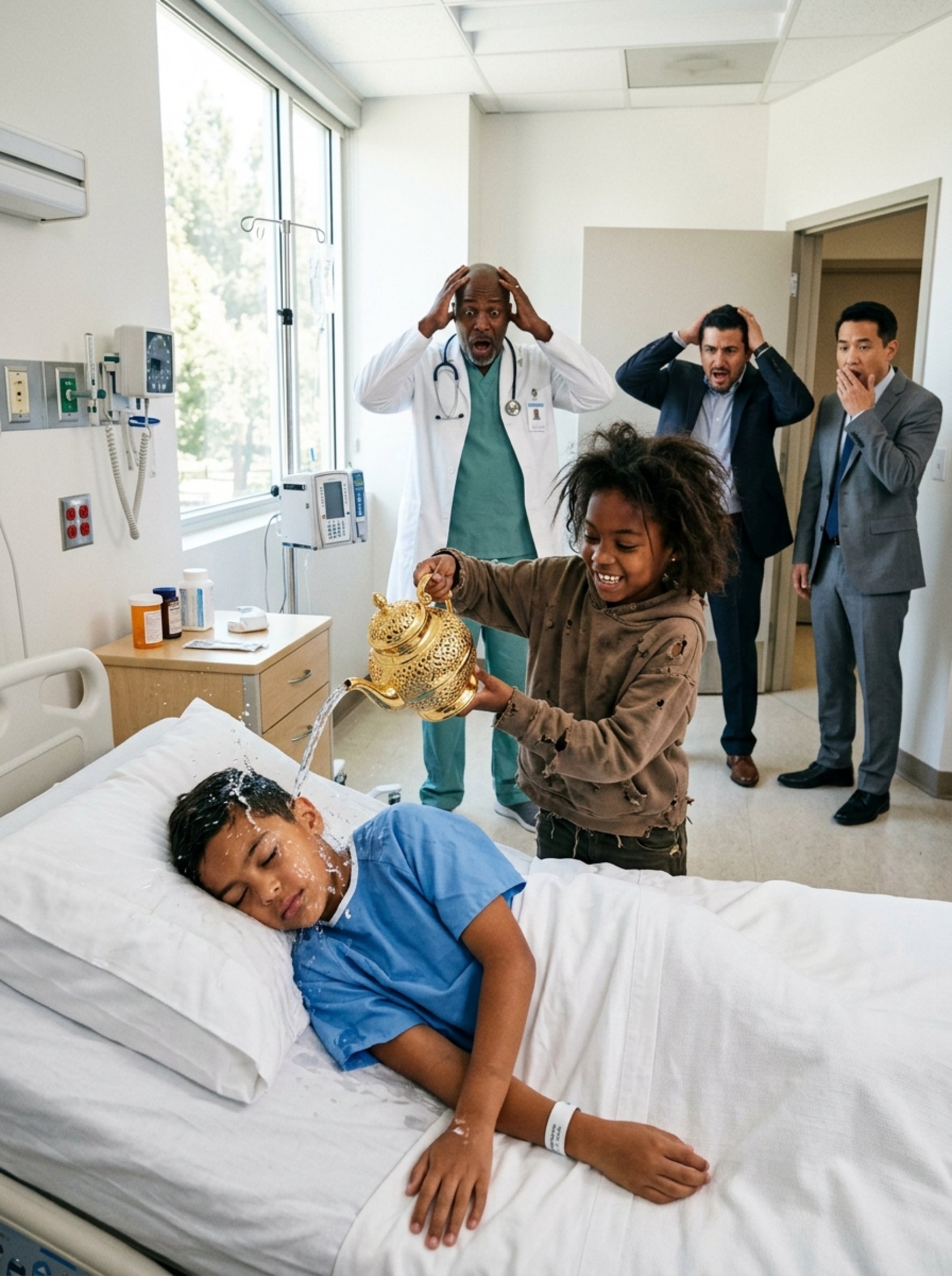
His son, three-year-old Noah, lay connected to machines that beeped with merciless patience. Each passing day, the child seemed paler, thinner, lighter—as though life itself were quietly erasing him.
When Brian, the head of pediatrics, asked David to step aside so they could speak “somewhere calm,” David felt the floor tilt beneath him.
“We have tried everything,” the doctor said in a gentle voice. “Several treatments. Specialists from here and overseas. Noah’s condition is extraordinarily rare. In the few cases recorded worldwide… no patient survived.”
David’s hands curled into fists.
“How long?” he asked.
Brian lowered his eyes.
“Five days. Possibly a week. At this point, all we can do is keep him as comfortable as possible.”
Something inside David broke without making a sound.
Noah had always been motion and laughter—sticky hands, sugar on his fingers, tiny feet racing endlessly from room to room. He had been noise, warmth, and life itself.
Now Noah looked unbearably tiny in the hospital bed, swallowed by white sheets, surrounded by tubes, cords, and blinking machines.
“There has to be something else,” David pleaded, his voice cracking. “Money doesn’t matter. Whatever it costs.”
The doctor’s expression softened, but his answer did not change.
“Sometimes medicine reaches the edge of what it can do,” he said quietly. “I’m sorry.”
When the doctor left the room, David sank into the chair beside the bed and wrapped both hands around Noah’s cold little fingers. The tears came before he could stop them.
How am I supposed to tell Emily? he thought.
His wife was in Seattle for a medical conference. She was due back in two days. Two days—when their son had only five left.
Then the door opened again.
David expected a nurse.
Instead, a little girl slipped inside.
She couldn’t have been older than six. Her school uniform was faded and worn, and over it hung a brown sweater much too large for her small frame. Her dark hair was tangled, as if she had been running. Clutched tightly in her hand was a cheap plastic bottle, painted a dull gold.
“Who are you?” David asked, stunned. “How did you get in here?”
The child said nothing. She walked straight to the bed, climbed onto a small stool, and looked down at Noah with a grave certainty that no child her age should have possessed.
“I’m going to save him,” she said.
Before David could understand what was happening, she twisted open the bottle and began carefully sprinkling water across Noah’s face.
“Hey—stop that right now!” David shouted, jumping to his feet.
But it was already done.
He snatched the bottle from her hand and slammed his finger against the call button.
“What are you doing? Get out of here!”
Noah gave a faint cough… then settled back into sleep.
The little girl reached desperately for the bottle again.
“He needs it,” she insisted. “It’s special water.”
Nurses burst into the room. From somewhere in the hallway, a woman’s terrified voice cried out.
“Chloe! What have you done?”
A cleaning woman, perhaps in her thirties, rushed into the room with fear shining in her eyes.
“I’m so sorry,” she said, pulling the little girl against her. “My name is Maria. She’s my daughter. She has no business being in here.”
“Hold on,” David said, his voice low and careful. “How does your daughter know my son’s name?”
Maria went rigid.
“I… I work here,” she stammered. “Maybe she saw him somewhere—”
“No,” Chloe interrupted at once. “I know him. We played together at Grace’s preschool. He’s my friend.”
The words struck David like a blow straight to the chest.
“My son has never been to preschool,” he whispered.
“Yes, he has,” Chloe replied simply. “We played hide-and-seek. He laughed all the time.”
Maria seized Chloe’s hand and hurried out with her before David could ask another question.
For a long while, he stood staring at the bottle. Plain water. Clear, odorless, ordinary. Nothing about it looked remarkable.
And yet the certainty in that child’s voice would not leave him.
That afternoon, David called Olivia, Noah’s nanny.
“Tell me the truth,” he said. “Did you ever take him to preschool?”
Silence stretched across the line.
“Only twice a week,” Olivia admitted at last. “He was lonely. He was happy there.”
The preschool was in Eastwood, in a poor part of town David had never once set foot in.
That night, he did not leave the hospital. Around midnight, a whisper pulled him from an uneasy sleep.
Chloe had come back.
This time she was not pouring water. She only held Noah’s hand and murmured something too softly for David to understand.
“You shouldn’t be here,” he said, but there was no strength behind the words.
“He needs me,” the girl answered.
Then she pointed to Noah’s face.
David looked—and his heart clenched. Noah’s skin seemed different. Not well, not healed, but somehow less ashen than before.
“What kind of water is that?” David asked.
“From the fountain in the inner courtyard,” Chloe answered.
“My grandmother says it used to be a well,” Chloe said. “People who were sick would come for the water.”
“That’s only an old story,” David muttered.
Chloe tilted her head, studying him.
“You believe the doctors, don’t you?”
“Yes.”
“And they told you they couldn’t help him anymore. So why can’t you believe in the water too?”
David had nothing to say.
A nurse named Hannah came in then and stopped short when she saw Chloe beside the bed.
“David,” she said in a low voice, “I’m not supposed to tell you this, but… after the little girl was here earlier, Noah’s oxygen level went up a little. Just a little,” she added quickly, “but it stabilized.”
Something dangerous and bright flickered inside David.
Chloe stayed a few more minutes. She talked to Noah about preschool, about how he always used to laugh during nap time.
By dawn, she was gone.
David picked up the gold-colored bottle. Then he dipped his fingers into the water and touched Noah’s forehead with it, the way his own mother had once done for him.
“If there is anything out there,” he whispered, “please.”
Noah’s eyes opened.
“Dad,” he mumbled. “Chloe came.”
David fell apart.
The days passed. Noah did not die.
Slowly, in a way no one could explain, he began to get better.
The water tests showed nothing unusual. “Ordinary,” the report said.
But Noah was alive.
Weeks later, he was walking again, his small hand wrapped around Chloe’s.
David began helping Grace’s kindergarten. Quietly. Without cameras. Without speeches.
Years later, Noah kept the empty gold bottle on his desk.
“It wasn’t the water,” he told Chloe once. “It was you.”
David watched them together, and at last he understood.
When the world had given them five days, a poor little girl had walked in with a cheap bottle—and given them their lives back.