
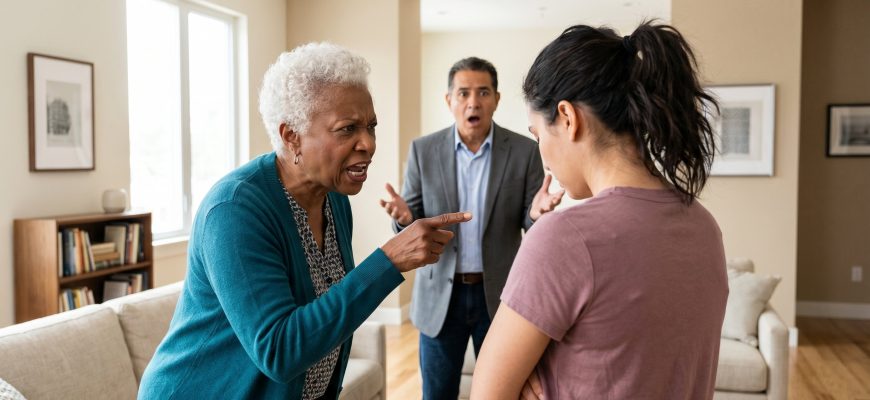
“I know what it is,” Michael said quietly. “It’s payback.”
Emily said nothing. She searched herself for pity, for satisfaction, for some sharp little spark of triumph—but there was none. Only a hollow calm.
“My mother…” Michael’s voice broke. “She’s sick too. Stomach cancer. Stage four. They say she has three months left, maybe less.”
“I’m sorry,” Emily said.
And she meant it. She was sorry, but not the way she would have been before. Not with that old, heavy pity that made her endure things she never should have endured.
“She asked me to tell you…” He swallowed hard. “She wants your forgiveness. She said you were right. That she ruined my life. And our marriage.”
Emily looked away.
“It’s too late for apologies.”
“I know.” Michael lowered his head. “I understood everything too late. When you left, I kept thinking you’d come back. Then Mom started feeling worse. First it was her stomach, then the test results, then the diagnosis. And I… I was left alone with her. I wash her, feed her, give her medicine. And only then did I understand what it must have been like for you to live with us for three years.”
Emily sat down on the edge of the bench.
“What do you want from me, Michael?”
“Nothing.” He shook his head. “I only wanted you to know. We got what we deserved. My mother is dying in pain, and I’m… disabled at thirty-four. My business collapsed. My friends disappeared. I sit in an empty apartment with a sick woman who is suddenly apologizing to everyone she ever hurt. But it’s late. Everything is too late.”
Leaning heavily on his crutches, he pushed himself up and began to move away, one slow, uneven step at a time.
Emily watched him go, thinking how strangely life balanced its own accounts. For three years she had swallowed humiliation, believing that someday things might become different. For three years she had been treated like a servant, like someone shameful, someone who needed to be hidden. And now both of them were broken, ill, and paying for what they had done.
But Emily felt no victory. Only relief.
She had left in time. She had saved herself in time.
That evening, Emily met Karen at a café. The chief doctor had invited her to talk and offered her a new position—senior administrator, with a salary one and a half times higher than before.
“You’re doing excellent work,” Karen told her. “You’re responsible, organized, dependable. And I can see how much you’ve changed these past few months. It’s as if you’ve come back to life.”
Emily smiled softly.
“That’s exactly what happened,” she said. “I came back to life.”
A week later, a message arrived from an unfamiliar number.
“Patricia died yesterday. The funeral is the day after tomorrow. Michael.”
Emily read it, let out a long breath, and deleted the message.
She would not go to the funeral. Not out of spite. Not out of revenge. That chapter had simply ended. Her mother-in-law had died without truly making anything right, because words spoken from a deathbed could not undo years of cruelty. And Michael had remained lonely and disabled because, throughout his life, he had chosen his mother over his wife, comfort over truth.
As for Emily, she simply kept living.
She rented a one-bedroom apartment in a newly built complex in a quiet neighborhood outside the city. She did the decorating herself—painted the walls a warm pale beige, put up wallpaper, mounted shelves. She met her neighbor, Nancy, a woman of about sixty who brought her pastries and told stories from her youth as if they had known each other for years.
At the clinic, they offered Emily professional training—a course in medical management. She accepted without hesitation.
One Saturday morning, she stood on her balcony with a cup of coffee in her hands. Down in the courtyard, children kicked a ball back and forth, teenagers rode scooters, and elderly women sat together on the benches, talking in the sun. The sky was bright. Clouds drifted lazily overhead.
Her phone vibrated.
A message from Sarah appeared on the screen.
“How are you, girl? We haven’t seen each other in forever. Movie today?”
Emily smiled and typed back, “Let’s do it. You pick the movie.”
She finished her coffee, set the cup down, and stretched deeply. The air smelled of spring, freedom, and new beginnings.
Michael and his mother had received what was coming to them—not because Emily had wished it upon them, but because life had arranged things in its own way. People who cause pain eventually find themselves alone with the pain they created. Patricia had died frightened and isolated because she had never learned how to love. Michael had lost his family, his business, and the future he once took for granted.
Emily, meanwhile, had begun again.
Not to punish anyone. Not to prove anything. Simply because she had the right to.
She went back inside, changed into jeans and a light blouse, and picked up her purse. In the mirror, a woman with clear eyes and a calm face looked back at her. Not the timid, wounded Emily who had hidden for three years in that “den.” Someone new stood there now—free, steady, alive.
She left the apartment, walked down the stairs, and stepped out into the spring sunlight.
The old life, with all its humiliations and fears, remained behind her.
Ahead was the future—uncertain, yes, but hers.
And that was more than enough.