
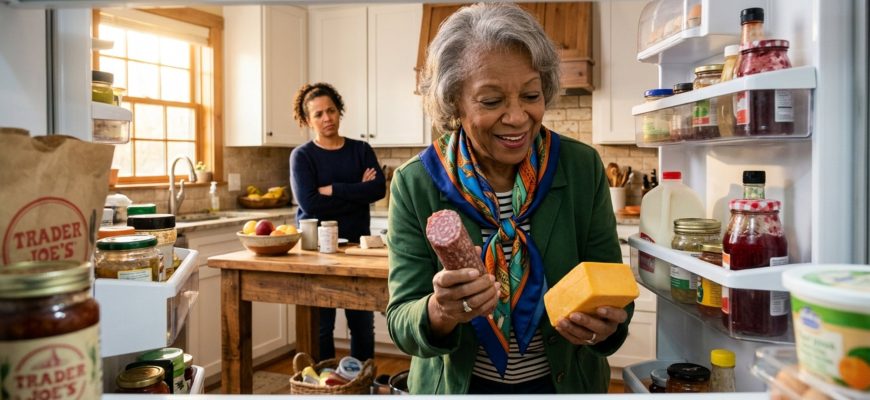
Two quiet days passed. Linda didn’t show up, only called once to complain about the chilly wind and the rising price of medication. Everything in the refrigerator remained exactly where Emily had left it. Gradually, she began to doubt herself. Maybe exhaustion really was playing tricks on her memory. Maybe she had imagined the earlier shortages.
Then Friday morning arrived with a phone call.
“Emily, sweetheart,” Linda cooed, her voice syrupy and overly warm. “I’ll be near your place today—I need to stop by the pharmacy. I could pop in and water your plants. Michael mentioned the ficus is looking droopy. Poor thing shouldn’t suffer.”
“I watered it yesterday,” Emily replied carefully.
“Oh, you’re always rushing, doing everything halfway,” Linda sighed theatrically. “Plants need a practiced hand. Don’t worry, I’ll be in and out. Maybe I could make you some soup while I’m there?”
“No, thank you. We have food,” Emily answered firmly. The last thing she wanted was her mother-in-law rearranging pots and pans in her kitchen.
“Well, suit yourself. I’m off then. Have a lovely day, dear.”
At work, Emily couldn’t focus. The numbers in her reports blurred together. Her thoughts kept drifting home. She pictured Linda unlocking the door with her spare key, stepping inside as if it were her own apartment. What was she doing there? Opening cabinets? Checking drawers? Or walking straight to the fridge?
The moment Emily returned home, she went directly to the kitchen. Her pulse hammered in her ears.
The refrigerator greeted her with a hollow chill.
The baked pork was gone. The butter—marked with her tiny dot—had vanished. Out of a dozen eggs, only two remained in the carton. Worst of all, the jar of red caviar she had bought on sale and hidden behind jars of pickles for New Year’s was nowhere to be found.
Emily sank onto a stool and covered her face with her hands. This wasn’t amusing anymore. It wasn’t forgetfulness. It was brazen theft. And the cruelest part was that she had no idea how to explain it to her husband. She had no undeniable proof. Linda could easily deny everything, claim Emily had eaten it herself or imagined buying it in the first place.
That evening, the tension finally spilled over.
“Michael, the caviar is gone. And the meat. And the butter,” Emily said while he was eating dinner—she had been forced to boil dumplings since the planned roast had disappeared.
Michael set down his fork slowly, his expression darkening.
“Again? Emily, you’re scaring me. Maybe you should see a doctor. A neurologist, perhaps. How does caviar just vanish?”
“Your mother came by today.”
“And? She watered the plants! Do you honestly think she—an educated woman, a retired teacher—would steal food from her own son? Why would she need to? She has her pension, and I give her money every month.”
Emily froze. “You give her money? How much?”
He shifted uncomfortably, avoiding her gaze. “Five to seven hundred dollars. For medication, utilities… It’s hard for her alone.”
“Five to seven hundred…” Emily repeated quietly. “Michael, we have a mortgage. We haven’t taken a vacation in three years. And you’re secretly giving your mother money?”
“She’s my mother!” he snapped. “I don’t have to report every dollar I spend on my parents. And stop accusing her. If you’re being forgetful or careless, don’t blame someone else!”
They went to bed that night without saying goodnight—something that hadn’t happened in years. Emily lay awake in the darkness, staring at the ceiling, listening to Michael’s wounded, exaggerated sighs. Inside her, something shifted. Doubt gave way to cold determination. She didn’t just need the truth anymore. She needed irrefutable evidence—something so solid that Michael would have no room left for excuses.
On Saturday, she drove to an electronics store. After a long discussion with a sales associate, she selected a small surveillance camera. It had to be discreet, capable of recording onto a memory card, and activated by motion.
“This one should work perfectly,” the young salesman in a bright yellow shirt assured her, handing over a compact black device. “HD video, records audio, runs up to a week on battery. You can hide it on a shelf or behind books.”
Back home, while Michael was out in the garage, Emily installed it. The top shelf of the kitchen cabinet proved ideal—the one that held rarely used vases and an old tea set. She positioned the camera between a sugar bowl and a jar of bay leaves, angling the lens toward the refrigerator and part of the counter. From below, it was invisible, but it offered a clear view of everything that mattered.
Now she needed bait.
On Sunday, making sure Michael was watching, Emily deliberately stocked the refrigerator to the brim. She bought expensive smoked sausage, another wedge of quality cheese, a pound of fresh beef, trout, fruit, and a large box of premium chocolates.
Michael stared at the overflowing shelves and raised his eyebrows. “Wow, are we expecting guests or something?”