
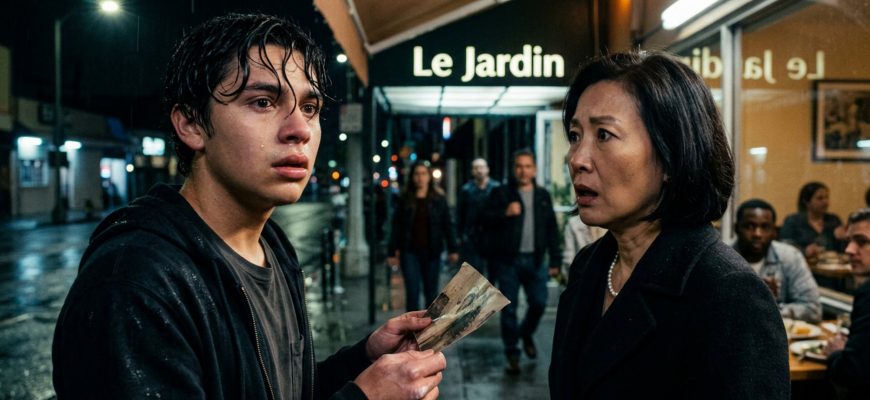
Before his mother passed away, she forced him to say one sentence back to her three separate times.
Find the woman from the picture.
Make sure she looks you in the eye.
Then ask her why she abandoned you in the rain.
Jason remembered every syllable the moment the black sedan eased to a stop in front of the restaurant.
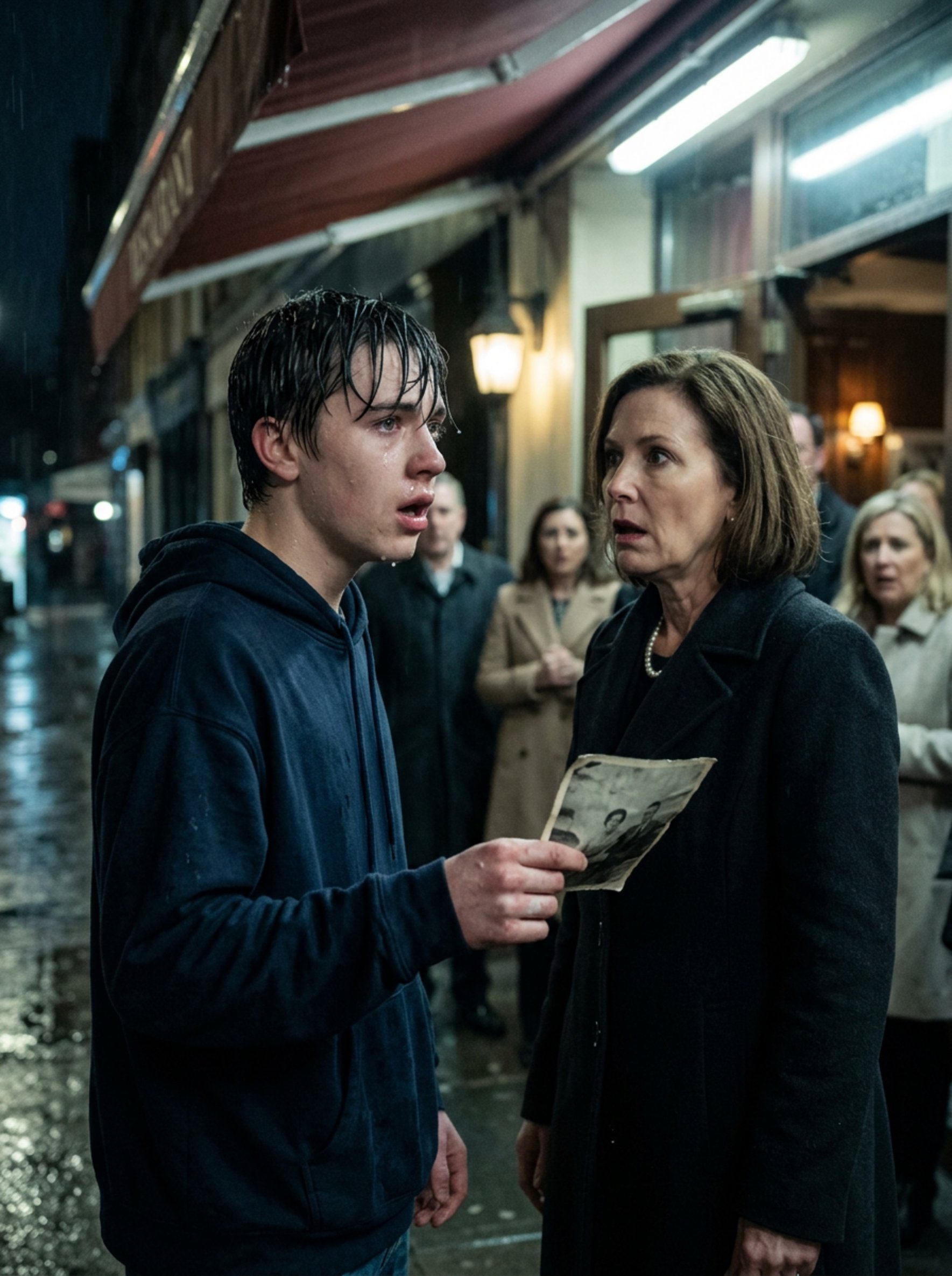
Rain hammered downtown Chicago, smearing the streetlamps into hazy rings of gold and coating the pavement until it gleamed like dark glass. Beneath a broad black awning, the entrance of Bellamont House shone warmly. Valets darted between arriving cars. Well-dressed guests laughed under umbrellas, brushing water from wool coats and silk scarves before slipping through brass doors into heat, candlelight, wine, and glittering chandeliers.
Across the street, Jason stood with a plastic bucket gripped in both hands.
He was seventeen. Rain had soaked him to the skin. His hoodie clung heavily to his shoulders, and his sneakers were filled with icy water. Dark hair lay plastered to his forehead. His fingers had gone stiff around the bucket handle.
In the pocket of his jacket was the photograph.
Folded twice.
Sealed inside a plastic sleeve.
It was the only thing his mother had left behind besides a letter, a hospital bracelet, and a question that had gnawed through nearly every year of his life.
The black sedan glided up to the curb.
Jason forgot how to breathe.
For three weeks, he had watched every video he could find of this woman.
Charity events.
Restaurant launches.
Museum benefits.
Interviews about women and leadership.
Magazine profiles that described her as graceful, private, untouchable.
Lauren.
Owner of Bellamont House.
Widow of one of the wealthiest real estate developers in the city.
The woman whose face had been hidden in a drawer beside Jason’s mother’s bed for as long as he could remember.
A valet opened the rear door.
Before fear could negotiate with him, Jason stepped off the curb.
One stride.
Then another.
Then he broke into a run.
“Hey!” someone yelled.
Jason raised the bucket and flung the filthy water across the side of the sedan.
The impact sounded almost violent.
Mud and rainwater streamed over the flawless black paint, splattered across the chrome handle, and ran down the rear window.
Gasps rippled through the crowd.
One valet froze, both hands lifted uselessly in the air.
Phones appeared at once.
The restaurant doors swung wider as guests turned toward the scene, eager for scandal before they even knew what they were witnessing.
The rear door flew open.
Lauren stepped out.
A dark evening gown showed beneath her wool coat. Pearls rested at her throat. Her hair had been swept back perfectly, untouched in appearance even by the storm. She was beautiful in a cool, expensive way, the sort of woman who made strangers lower their voices before addressing her.
Now rage lit her face.
“ARE YOU OUT OF YOUR MIND?” she shouted.
Jason stood only three feet from her, the empty bucket dangling from one hand.
He was crying already.
Not loudly.
Not in a way meant to draw pity.
It was the kind of crying that came when anger had been decaying into grief for years and finally found the person it had been waiting to confront.
The gathering fell quiet.
Lauren looked him over from head to toe.
“Who are you?”
Jason’s chest rose and fell in sharp, uneven pulls.
“You left my mother standing in the rain.”
Her eyes narrowed.
“What did you say?”
“You walked away and never looked back.”
For a single second, her expression remained hard.
Then something shifted.
A pause.
A fracture so fine that most people would never have noticed it.
But Jason had spent his entire life searching for cracks in a story no one had ever explained.
He noticed.
Lauren swallowed.
“I have no idea what you’re talking about.”
“Yes, you do.”
The valet started toward him.
Jason stepped backward and shoved one hand into his pocket.
“Don’t touch me.”
The valet stopped.
Jason’s fingers trembled so violently he almost dropped the photograph. He pulled it out, unfolded it, and held it beneath the restaurant lights.
Without meaning to, the crowd leaned closer.
Lauren lowered her gaze.
The old photo was faded, creased, its edges softened by years of being handled by someone who had loved it and hated it at the same time.
It showed Lauren much younger.
Drenched by rain.
Hair stuck to her face.
A white blouse plastered to her shoulders.
She stood beneath what appeared to be a bridge or an underpass.
In her arms was a baby wrapped in a blue blanket.
She held him tightly.
Shielding him from the storm.
Jason lifted his eyes to hers.
“My mother told me you were my real mother.”
Lauren stopped breathing.
The fury drained from her face.
So did the polished mask.
So did the untouchable wealthy woman who knew exactly how to command a room.
For one moment, she looked like someone who had just watched a body climb out of a grave.
The phones kept recording.
Rain drummed against the awning.
Somewhere behind Lauren, a man called, “Lauren?”
She did not respond.
She stared at the photograph.
Then she looked at Jason.
Her lips parted.
And then she said the one sentence his mother had never warned him to expect.
“I knew this day would come.”
The Photograph Hidden Under the Mattress
Jason’s mother was not the woman in the picture.
Not by blood.
He found that out three days before she died.
Her name was Maria, though almost everyone in their neighborhood called her Maria anyway, with warmth that made it sound like family. She worked double shifts cleaning office buildings, hospitals, and the lobbies of luxury apartment towers where residents passed by her reflection without ever really seeing her.
She raised Jason in a third-floor apartment that always smelled faintly of coffee, laundry detergent, and rice simmering with garlic. None of their furniture matched. Cold air slipped through the windows every winter. The elevator broke down so often that by the time Jason was eight, he had already learned to carry groceries up the stairs.
But he never once questioned whether he was loved.
Not even for a moment.
Maria loved him loudly.
Relentlessly.
Completely.
She kissed his forehead in public until he became tall enough to dodge her. She made him text whenever he arrived anywhere, even if he was only going downstairs. She clipped coupons with the precision of a battlefield commander and somehow produced birthday cakes even in years when rent swallowed nearly everything they had.
She never spoke about the night she found him.
Not until cancer made secrets heavier than silence.
By then, Jason was seventeen and doing his best to pretend the hospital bed in their living room was temporary.
Maria refused hospice for as long as her body allowed.
“I don’t want strangers wandering through my home like I’m already dead,” she told him.
So Jason learned medication schedules. He learned oxygen tubes, pharmacy calls, and how to sleep lightly enough on the couch to wake at the smallest cough.
One stormy night, she asked him to bring her the old cookie tin from beneath her mattress.
He knew exactly which tin she meant.
He had seen it while changing her sheets, but he had never opened it.
Maria watched as he set it on the blanket.
Her hands had grown thin, the veins raised beneath her skin like blue thread.
“Open it,” she whispered.
Inside were three items.
A folded photograph.
A hospital bracelet with no baby name printed on it.
And an envelope sealed shut with tape.
Jason picked up the picture first.
His brow furrowed.
“Who is this?”
Maria closed her eyes.
“Your mother.”
He gave one short laugh.
Not because anything about it was funny.
Because the words had nowhere to fit inside his mind.
“You’re my mother.”
“Yes,” she said. “I am.”
“Then what are you talking about?”
Tears gathered in her eyes.
“The woman who gave birth to you.”
The room seemed to tip sideways.
Rain struck the window in hard bursts.
The oxygen machine hummed beside the bed.
Jason stared at the photograph again.
A young woman in a storm.
A baby in her arms.
Him.
“No.”
“Jason—”
“No.”
Maria reached for him.
He backed away.
Pain crossed her face, but she did not try to defend herself.
That hurt him more than if she had.
“I found you beneath the Roosevelt Bridge,” she said softly. “You were three months old. Maybe four. It was pouring. She was there.”
“The woman in the picture?”
Maria nodded.
“She was holding you and crying so hard I thought she had been hurt. I was coming home from work, and I saw her near the underpass with you wrapped in that blue blanket.”
Jason’s throat tightened.
“What happened?”
“She begged me to take you.”
He shook his head.
“No.”
“She said she couldn’t keep you safe. She said people were watching her. She told me that if they found you, they would turn your life into a weapon.”
“What people?”
Maria swallowed.
“She wouldn’t tell me.”
“Why didn’t you call the police?”
“I tried.”
“You tried?”
“She grabbed my phone and said if I called them, they would be the first ones to know where you were.”
Jason’s anger rose quickly, because fear needed somewhere to go.
“So you just took me?”
Maria flinched.
“Yes.”
“You took a stranger’s baby under a bridge?”
“She placed you in my arms.”
“That’s insane.”
“I know.”
“Why would you do that?”
Then Maria began to cry.
Not dramatically.
She cried like a woman who had been carrying the answer in her chest for seventeen years.
“Because you were cold.”
Jason said nothing.
“She put you in my arms, and you grabbed my shirt with one tiny hand. You stopped crying. You looked up at me like you had already made a decision. Then the woman told me your name.”
“My name?”
“She said, ‘His name is Jason. Please don’t let them rename him.’”
The room fell utterly still.
Maria reached for the envelope inside the tin.
“I saved everything. The bracelet. The photograph. The note she tucked inside the blanket. I meant to tell you when you were older, but then older turned into school, bills, asthma attacks, college applications, and I kept telling myself I would wait one more year.”
Jason’s anger cracked open.
“You lied to me.”
“Yes.”
“Every day?”
“Yes.”
He wanted her to deny it.
To soften the edges.
To tell him it had been something more complicated than a lie.
But she gave him the truth without dressing it up.
That was one of the reasons he loved her.
And one of the reasons it hurt so badly.
Maria made him sit beside her.
Then she made him repeat the sentence.
Find the woman from the picture.
Make sure she looks you in the eye.
Then ask her why she abandoned you in the rain.
He said it once.
Then again.
Then a third time, because she insisted.
“I need you to remember,” she whispered. “Not because she deserves you. Because you deserve the truth.”
Three days later, Maria died before dawn.
Jason stayed beside her body until the hospice nurse arrived.
The cookie tin remained on the bed.
And the photograph became heavier than grief.
The Woman Who Was Meant to Forget
Lauren did not move for several seconds after Jason showed her the picture.
Outside Bellamont House, the crowd watched in breathless silence.
Rain spilled from the edges of the awning in clear ribbons. The muddy water smeared across her sedan looked nearly black beneath the golden lights.
A man in a tuxedo stepped out behind her.
Tall.
Gray-haired.
Composed.
“Lauren,” he said in a low voice. “Come inside.”
Jason looked at him.
Something about the man’s expression made his stomach clench.
He was not shocked.
Not enough.
Lauren turned slightly toward him.
“No, Richard.”
The man’s jaw tightened.
“This is not the place.”
She gave a single broken laugh.
“Of course it isn’t.”
Richard looked Jason over with cold assessment.
“Young man, whatever you believe is happening here, you are wrong.”
Jason raised the photograph higher.
“I’m not speaking to you.”
Richard’s face hardened.
Lauren kept staring at the boy.
“What was her name?”
Jason’s fingers clenched around the picture.
“The woman who raised me?”
Lauren nodded.
“Maria.”
The name seemed to strike her physically.
She closed her eyes.
“Maria.”
“You knew her?”
“No.” Lauren opened her eyes again. “Not then. But I remembered her face.”
Jason’s anger flared.
“She remembered yours every single day.”
Lauren reached toward the photograph.
He pulled it away.
“No.”
She stopped immediately.
That surprised him.
“I’m sorry,” she said.
The words were too small.
He hated them for being so small.
Richard moved closer.
“Lauren.”
She snapped her gaze toward him.
“Do not say my name as though you’re managing a dinner reservation.”
A murmur moved through the crowd.
Richard lowered his voice.
“You’re being emotional.”
Jason saw Lauren’s face change at that word.
Anger did not come first.
Recognition did.
Old fear.
“Emotional,” she repeated.
Richard’s eyes flicked toward the phones.
“We can discuss this in private.”
“No,” Jason said.
Both adults looked at him.
All at once, he felt very young, standing there in soaked clothes before wealthy strangers and recording cameras.
But his mother’s voice came back to him.
Make sure she looks you in the eye.
Jason looked directly at Lauren.
“Private is how people disappear.”
The sentence struck harder than he had expected.
Lauren’s face collapsed for half a second.
Richard went completely still.
Someone in the crowd whispered, “What is going on?”
One of the valets asked, “Should we call security?”
“No,” Lauren said.
Then, louder, she repeated it.
“No one touches him.”
Richard looked furious now.
“Lauren, that is enough.”
But she had already stopped listening to him.
She took a careful step toward Jason, then another, moving as if she were approaching a wounded animal that might bolt.
“They told me you were dead,” she said.
Jason nearly laughed.
“They told me you left me.”
Her eyes filled with tears.
“I did.”
The admission struck him like ice water.
The crowd went silent again.
Lauren continued, her voice unsteady.
“I left you with Maria because I believed it was the only way you would survive.”
Jason’s throat tightened.
“What is that supposed to mean?”
Richard’s voice cut in sharply.
“Lauren.”
She ignored him.
“You were born at St. Anne’s Hospital,” she said. “I was twenty-two.”