
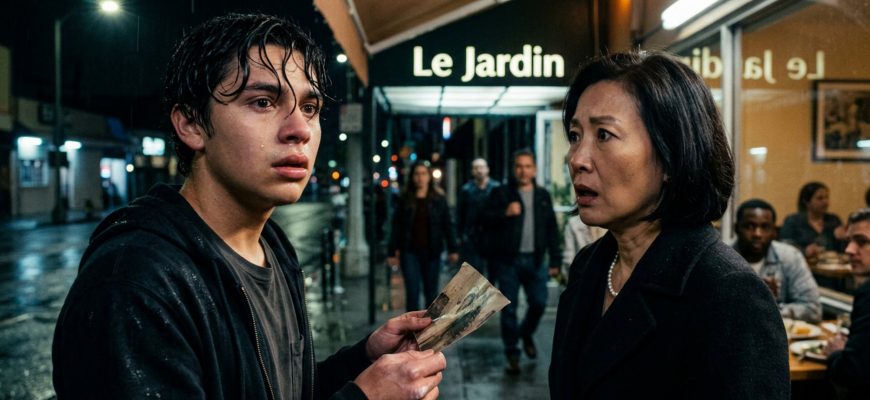
“—a child your own system insisted did not belong to her. If anyone in this courtroom has earned the right to be called family, it was her.”
That was what finally broke Lauren completely.
Not because the words pushed her out.
Because they were undeniable.
The Family That Could Not Be Put Back Neatly
When the trial ended, everyone seemed hungry for a simple story.
They wanted an embrace.
They wanted Jason and Lauren to fall into each other’s arms.
They wanted Michael to wake up whole.
They wanted a stolen family returned to its proper shape, Maria honored, Richard condemned, and the damage sealed inside a tidy ending.
But life would not cooperate.
Michael did get better, though recovery came in slow, uneven pieces. There were mornings when he knew Jason immediately, and there were others when Jason was only a familiar face he could not quite place. His speech returned in broken bits. Certain songs made him weep without explanation. Once, when someone showed him a picture of Maria, he smiled and said her name clearly enough that Jason had to step outside before he fell apart.
Lauren purchased a house close to Michael’s care center.
Jason did not go live with her.
He remained in the apartment until the lease ran out. After that, he took a modest place of his own, paid for partly through money Maria had legally left him and partly through restitution ordered after the case.
One time, Lauren offered him the Whitmore mansion.
Jason only stared at her.
After a few seconds, she lowered her eyes and said, “That was a terrible thing to suggest.”
“Yes,” he answered. “It was.”
“I’m trying to learn.”
“Try faster.”
She accepted that with a nod.
Whatever relationship they built began carefully, over dinners that felt supervised even though no judge had required them. The supervision was emotional, not legal.
At first, they chose ordinary places.
Small restaurants.
Public parks.
A coffee shop near Jason’s school where Lauren looked so absurdly out of place that he almost laughed. She learned to ask for regular drip coffee without making it sound like she was negotiating with a board of investors.
She asked him questions.
Too many, sometimes.
He answered when he could.
Sometimes he answered harshly.
More often than he expected, she simply absorbed it.
Once, when he snapped, “You don’t get to start acting like my mother because you wrote sad cards every year,” Lauren went silent for so long that he thought she might leave.
Instead, she said, “You’re right.”
He hated that response.
It gave his anger nowhere to land.
Maria was his mother.
That did not change.
Lauren never tried to take her place.
That mattered more than Jason wanted to admit.
On Jason’s eighteenth birthday, Lauren did not give him a car. She did not hand him an expensive watch or a trust document. There was no grand gesture wrapped in wealth.
She gave him a box.
Inside were copies of every birthday card she had written over the years, along with one new letter.
Jason,
I am not asking you to give me the name Maria earned. I am asking only to know you in whatever shape the truth permits. I was your first mother for three months. She was your mother for seventeen years. Both are true. Only one of us was allowed to raise you. That loss belongs to me. It is not a debt you have to repay.
He read the letter twice.
Then he put it away.
Months passed before he took it out again.
That was where forgiveness started.
Not in a single dramatic instant.
In rereading.
Lauren sold Bellamont House.
The restaurant.
The one with the glittering entrance where Jason had thrown filthy water across her car.
With part of the money, she established the Maria Family Defense Fund, created to help parents, guardians, and relatives fighting forced family separation, fraudulent medical confinement, and private custody abuse.
Jason insisted Maria’s name come first.
Lauren did not argue.
No professional speechwriter was allowed near the opening statement.
At the launch, Lauren stood in front of the reporters and said, “Maria saved my son while I survived in the worst way possible. This fund exists because love without power still managed to resist what power tried to erase.”
Jason stood near the back with his arms folded.
He tried not to cry.
He failed, but quietly.
Michael lived long enough to walk through a garden with assistance three years after he was found. Jason moved beside him. Lauren walked on his other side.
Michael’s words came and disappeared without warning.
That afternoon, they came.
He stopped near a bench.
First he looked at Jason.
Then at Lauren.
In a thin voice, he whispered, “Bridge.”
Jason went still.
“What?”
Michael’s eyes shone.
“Rain.”
Lauren pressed a hand over her mouth.
Michael reached for Jason.
“Name,” he breathed. “Kept name.”
Jason broke then.
He bent over their joined hands, pressed his forehead against them, and sobbed harder than he had in the courtroom.
Michael did not recover every memory.
But he remembered enough to know what mattered.
Jason’s name had endured.
Because Lauren had begged.
Because Maria had preserved it.
Because Michael had loved before they took him away.
Because Richard had not succeeded in erasing everything.
Two years later, Michael died with Jason at one side of the bed and Lauren holding his other hand.
Maria’s photograph stood on the bedside table.
So did the old picture taken near the bridge.
No one in that room had truly received what they deserved.
Not completely.
But the truth was present.
Sometimes truth comes far too late to repair what was broken.
Even then, it can bear witness.
And that means something.
The Rain They Learned to Walk Through
Years later, Jason kept the photograph framed in his apartment.
Not one of the glossy reproductions entered into evidence during trial.
The original.
Lauren under the bridge.
Drenched.
Terrified.
Holding him.
He placed it beside a picture of Maria laughing in the kitchen, flour dusted across one cheek.
Visitors often looked at the two images and had no idea what to say.
Jason did not rescue them from the silence.
By the time he was twenty-seven, he had become an attorney. His work focused on families caught inside private custody arrangements, coercive medical declarations, and inheritance-related confinement. He specialized in the kind of legal paperwork that had once swallowed Michael whole.
Inside his desk drawer, he kept Maria’s instruction taped to the wood.
Find the woman in the photo.
Make her look at you.
Then ask why she left you in the rain.
Beneath it, in his own handwriting, Jason had added:
Then keep asking who made the rain her only choice.
Lauren worked with the defense fund until age began to slow her down. She and Jason never became an easy story.
They became honest.
That was better.
They argued.
Sometimes they laughed.
Once a year, during a rainy week in October, they visited Michael’s grave and Maria’s grave together. Jason insisted on the timing. He refused to let weather belong only to trauma.
On the tenth anniversary of the night outside Bellamont House, Lauren asked if he would go with her to the Roosevelt Bridge.
His first instinct was to refuse.
Instead, he said yes.
They went alone.
No cameras.
No journalists.
No public statements.
Just an older woman with silver threaded through her hair and a grown man who still carried a boy’s unanswered question somewhere beneath his ribs.
The bridge looked smaller than Jason had imagined.
Aging concrete.
Graffiti sprayed along one side.
Traffic rushing overhead in wet, hissing waves.
Rainwater spilled from the edge in thin strands.
Lauren stood beneath it and trembled.
“This is where I gave you to her,” she said.
Jason looked down at the wet pavement.
“Do you remember it exactly?”
“Yes.”
“What was I doing?”
Through tears, Lauren smiled faintly.
“You were quiet. That frightened me more than crying would have.”
“Why?”
“Because babies are supposed to protest when the world is cold.”
Jason swallowed.
“Did you believe you would see me again?”
Lauren closed her eyes.
“I believed that if I survived, I would find you. But surviving became smaller than I understood. I stayed alive inside the story they built around me.”
Jason listened.
The rain tapped against the concrete above them.
For years, he had waited for his anger to become unnecessary.
It never had.
But it had changed form.
It no longer needed to set fire to everything around it just to prove it existed.
“You should have found me sooner,” he said.
“Yes.”
“You should have trusted that Maria could help you again.”
“Yes.”
“You should have fought even if they called you unstable.”
Lauren’s voice cracked.
“Yes.”
He turned toward her.
“I needed to say that here.”
“I know.”
Then Lauren reached into the pocket of her coat.
“I brought something.”
She unfolded a small piece of paper.
Old.
Soft at the creases.
A photograph.
Not the picture of her holding him.
A different one.
Michael stood beneath the same bridge, young and alive, laughing in the rain, one hand lifted toward the camera.
Jason stared at it.
“I took this the day he told me he loved me,” Lauren said.
Jason accepted the photo carefully.
He had seen images of Michael before. Case files. Court exhibits. Medical records.
But never like this.
Never laughing.
Never whole.
He stood under the bridge and looked at his father’s face until the rain blurred everything.
“Can I keep it?” he asked.
Lauren nodded.
“It was always yours.”
They remained there for a long time.
Then Jason did something neither of them had expected.
He took Lauren’s hand.
Not exactly as a child reaching for his mother.
As a man recognizing that both of them had been abandoned in that rain, though not in the same way and not for the same price.
Lauren began to cry.
Jason let her.
He did not offer comfort made of lies.
He simply stayed.
The Question That Survived the Scandal
People still repeated the story of the teenage boy who threw a bucket of dirty water onto a rich woman’s black sedan outside a glowing restaurant.
They remembered the splash.
The stunned silence.
The phones lifting.
The furious woman in the dark evening gown.
The soaked photograph.
The sentence that stopped everyone cold:
She said you were my real mother.
And the woman’s reply:
I knew this day would come.
Those were the parts people liked.
The dramatic parts.
But Jason remembered what had come before.
Maria’s hospital bed.
The cookie tin.
Her thin hands making him repeat the words until he could say them without shaking.
Find the woman in the photo.
Make her look at you.
Then ask why she left you in the rain.
At first, he had been furious with her for leaving him a question instead of a clean answer.
Only later did he understand.
Maria had known the truth would not be clean.
She had known Lauren might be guilty and wounded at the same time. Cowardly and controlled. Loving and absent. Broken and responsible.
All of it could be true at once.
She had known Jason deserved more than one villain when so many hands had built the lie.
More than anything, Maria had known that he needed Lauren to look at him.
Not through attorneys.
Not through letters written years too late.
Not through grief.
Directly.
In public.
In a place where the lie could not be quietly escorted out a side door.
That was what the dirty water had done.
It ruined the polished surface long enough for what lay beneath it to be seen.
Years after Richard died in prison, after Michael was buried, after Lauren’s hair had gone completely white, and after the Maria Family Defense Fund had helped hundreds of families, Jason spoke at a conference about private family coercion.
He hated conferences.
He attended because someone had to say the uncomfortable thing in rooms filled with comfortable professionals.
“People ask why victims don’t leave,” he said from the podium. “But they ask as if leaving is a hallway everyone can see. In my family, every exit was guarded. Doctors guarded it. Lawyers guarded it. Money guarded it. Reputation guarded it. Security guarded it. And over everything was the threat that anyone who resisted would be labeled unstable. My mother Maria had none of those weapons. She had a baby placed in her arms in the rain, and she chose to protect him anyway.”
No one moved.
“My biological mother failed me,” he continued. “She also saved my life. My father was made to disappear. My adoptive mother was threatened. I was raised inside love and lies at the same time. That is not a contradiction. That is often what powerful abuse leaves behind.”
He glanced down at his notes.
Then he folded them and set them aside.
“The question is not only why someone left. The question is who made staying impossible. Who benefited from silence. Who preserved the proof when the world told them to move on.”
In the front row, Lauren wept openly.
Jason did not look away.
After the speech, a young woman approached him with a folder pressed tightly against her chest.
“My family says my aunt is unstable,” she whispered. “But she says they took her son.”
Jason’s expression shifted.
Not into pity.
Into focus.
“Start at the beginning,” he said.
That became the shape of his life.
Listening before a story had been polished clean.
Searching for the person left in the rain.
Asking who held the umbrella.
And who owned the storm.
When Lauren died, she left Jason all the birthday cards, Michael’s photograph, and one last letter.
My son,
Maria taught me that motherhood is not biology, sorrow, or intention. It is what you protect when protection costs you something. She was your mother in the fullest meaning of the word. I was your mother in the broken beginning. Thank you for allowing me to spend the rest of my life telling the truth about both.
Jason read the letter beneath the Roosevelt Bridge.
A light rain fell around him.
That day, he brought two flowers.
One for Lauren.
One for Maria.
Then he placed Michael’s photograph between them and stood under the concrete while water dripped from the edge. He remembered a night he could not truly remember, yet had carried inside him all his life.
A young woman in the rain.
A baby wrapped in a blue blanket.
Another woman reaching out.
A car waiting at the end of the street.
A choice no one should ever have been forced to make.
People liked to say that was the night Lauren abandoned him.
Eventually, Jason understood it another way.
That was the night three people tried to save him with the only choices they had left.
Michael, by loving Lauren before fear found them.
Lauren, by handing him away from the people hunting her.
Maria, by taking him and keeping his name.
None of it was enough to make the story painless.
But it was enough to keep him alive.
And sometimes being alive is the first truth.
The rest can take years.
Rain darkened Jason’s coat.
He did not move.
For a long while, he listened to the city passing above him.
Then he whispered the sentence Maria had given him, no longer as an instruction, but as a prayer finally answered.
“I found her, Mom.”
The rain kept falling.
This time, no one was left alone inside it.