
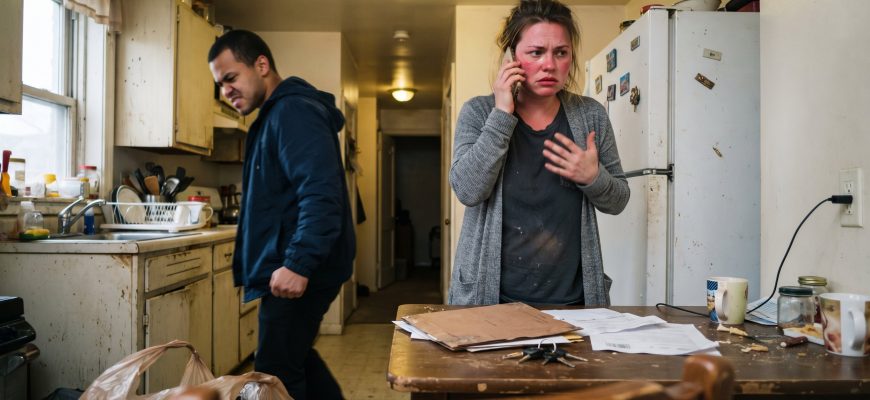
“You brought the kids to a locked gate because you decided my refusal didn’t count.”
Ryan slammed the back of the moving truck shut. The movers climbed into the cab. Ethan silently pulled his backpack out of the vehicle, while Olivia hugged her stuffed rabbit to her chest and looked not at the house, but at her mother. For the first time all day, that look made Jessica stop talking.
Michael came over to Emily once the others had begun piling back into the truck.
“Let’s not talk about divorce,” he said under his breath. “I’ll get the key back from Jessica. Just don’t make this bigger than it is.”
“You gave her the key. You promised her my house. You asked me to swallow it for your sister’s sake. Which part, exactly, am I not supposed to make bigger?”
“I was trying to help.”
“With my property.”
His face tightened.
“You reduce everything to paperwork.”
“Because when it came to being decent, you showed up with a moving truck.”
Michael opened his mouth to argue, but the officer was standing nearby, and behind him Jessica had started demanding that he pay half the cost of the movers. Suddenly, arguing became inconvenient.
“I’ll come get my things,” he said.
“Today. From six to seven. Sarah will be present. I’ll have a list ready.”
“You’re going to make me schedule an appointment to enter my own home now?”
“After today? Yes.”
He stared at her as if only then did he understand that the familiar Emily—the one who smoothed over fights, softened everyone’s sharp edges, and gave in before things became ugly—had not ended with a threat. She had ended with action.
That evening, Michael arrived at the city apartment to collect his belongings. Sarah, Emily’s cousin, sat at the kitchen table with a notebook and stayed out of the conversation. Two bags were already on the floor: Michael’s clothes, a box of papers, his laptop, and his fishing gear. Emily did not argue. She did not bring up the past. She simply handed over what was his and checked each item off the list.
“Sarah, could you give us a minute?” Michael asked. “My wife and I need to talk.”
“I’m here as a witness,” Sarah replied evenly.
Michael gave a short, humorless laugh.
“Emily, are you seriously going to throw everything away because of Jessica?”
“This isn’t because of Jessica. It’s because you made a decision for me.”
“I thought you’d understand.”
“No. You wanted to see whether I’d bend.”
He dropped his eyes to the bag.
“Mom says you’ve become a stranger.”
“Tell Linda that, for once, she’s right.”
Michael lingered near the door. It was obvious he was waiting for that final pause—the one where Emily usually surrendered. Where she would ask them not to fight, suggest they talk tomorrow, search for a compromise on everyone else’s behalf. But today, the compromise had already driven away in a white moving truck without unloading a single box.
“I’ll return the house key,” he said.
“Today.”
“Jessica has it.”
“Then get it from Jessica and bring it back today.”
Michael looked ready to flare up, but his eyes shifted to Sarah, and he held himself back.
Two hours later, he sent a courier with an envelope. Inside was the key on a red keychain. The same one Jessica had been waving at the gate.
Emily photographed it, put it in a drawer, and sent Michael one message: “Received. Any other matters in writing.”
The next day, Jessica sent a long text. She wrote that the children had slept on folding cots at their grandmother’s, that Ryan had paid for the moving truck for nothing, and that Emily could have “acted like a human being” and understood their situation. At the end, she added: “We weren’t taking it away. We just wanted to live there for a while.”
Emily answered briefly, without theatrical cruelty: “You can live in someone else’s house only with the owner’s permission. I did not give mine.”
Jessica did not write again.
By the evening of June 11, Emily drove out to the Birch Grove property and fastened a new sign beside the old brass plaque: “Entry by owner’s permission only.” No decorations. No long explanations. Just enough so that the next person with someone else’s key could not pretend they had misunderstood.
The house was clean, quiet, and empty of other people’s belongings. There were no boxes of Ryan’s in the shed. No bags of Jessica’s lay in the rooms. No moving truck waited at the gate. Michael stopped writing in that commanding tone, and Linda stopped calling to lecture her about family duty.
Emily walked around the lot, adjusted the latch, and checked the door. Then she sat on the porch step and opened her list of chores: the path by the entrance, the lilacs along the fence, a shelf in the pantry. Ordinary owner’s work. The kind no one noticed until they suddenly decided the house was somehow “shared.”
Her phone flashed once.
Sarah had written that Jessica had rented a small house in the next district. For money. Without a porch, without a garden, and without another woman’s home to pressure her way into.
Emily read the message and put the phone away. She felt no joy. Only a plain, understandable conclusion: someone else’s life had finally been arranged without being paid for by her.
She closed the gate, checked the latch one more time, and went inside.
On the other side of the door remained other people’s keys, other people’s plans, and their old habit of deciding for her.