
She had died in a car crash—on the very same day Matthew lost his sight.
Richard had always insisted the music box disappeared during the move.
Yet here it was.
Hidden inside the wall.
When Sophia pried it open, there was no porcelain ballerina turning to a melody. Instead, a photograph had been tucked inside. Matthew at seven years old, grinning brightly beside his mother. On the back, written in frantic, uneven script:
“I don’t know how to keep this hidden. The boy saw everything. I can’t let Richard find out. It would destroy all of us.”
The silence that followed felt suffocating, as if the room itself refused to breathe.
Matthew hadn’t gone blind from shock.
He had lost his vision because his mother had tried to bury something—shielding both him and Richard from the truth.
“What did I see?” Matthew murmured, his voice trembling.
“The memory is reconnecting,” Sophia replied quietly. “The link has been restored.”
Matthew clutched his temples.
“The car… it wasn’t an accident,” he said hoarsely. “I saw it before Dad came home. She wasn’t alone.”
A faint scrape echoed behind them.
From behind a concealed maintenance panel stepped a man—Daniel, a former engineer Richard had dismissed years earlier.
He raised a gun, aiming straight at Sophia.
“The girl has to die,” he hissed. “She’s ruined everything.”
Chaos erupted.
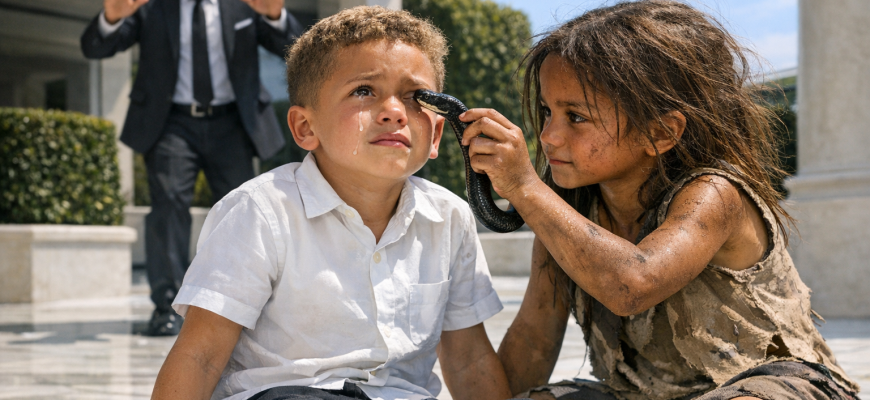
Without hesitation, Sophia hurled the Nocturne at his face. Drawn to fear like a predator to blood, the creature latched onto his skin.
Richard lunged.
Under the crushing weight of panic and the living darkness clinging to him, Daniel broke. He confessed it all—embezzlement, threats, the relentless pursuit that had forced Matthew’s mother off the road. Matthew had witnessed it. Every second.
The Nocturnes had never been the illness.
They were the cure—engineered to seal traumatic memories behind a veil of darkness when the mind could not survive the light.
—
The End of Night
Sirens wailed in the distance. Police stormed the house. Daniel was taken away in handcuffs.
Matthew’s vision returned gradually—first in blurred shapes and washed-out light, then sharpening into focus.
The first face he truly saw was Sophia’s.
“Why did you help me?” he asked, tears sliding freely down his cheeks.
She gave a small shrug.
“I had one too,” she said. “Mine didn’t blind me. It taught me how to recognize the darkness in others.”
At dawn, she left without accepting a single dollar. She asked only one thing in return:
That Matthew would face what he now knew.
Because the deepest blindness isn’t physical.
It’s the kind we choose when we’re too afraid to look directly at our own pain.
And that kind of sight is something no billionaire on earth can ever buy.