
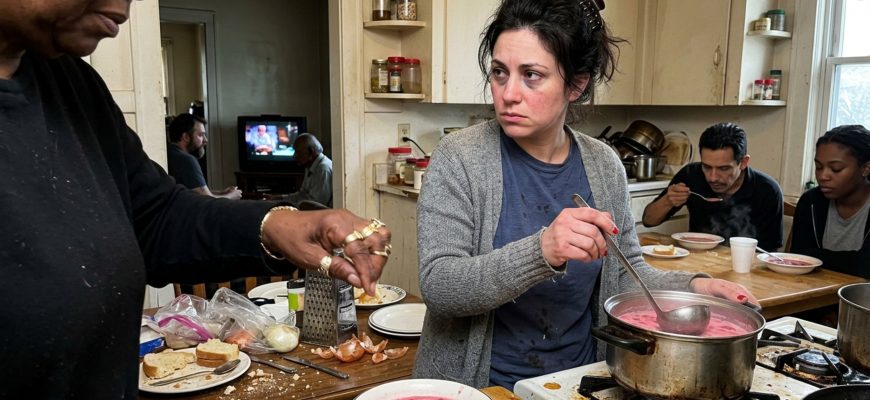
“And I’m not?” Barbara snapped back. “I spent ten hours on a train. Somehow I’m still smiling.”
I shut my laptop. My fingers were buzzing from the keyboard, and my back ached in a deep, stubborn line. There were still twenty-nine days left in the month.
On the third day, Barbara rearranged the living room.
I came home from the grocery store carrying four bags—about twenty-five dollars’ worth of food—and stopped in the doorway because I didn’t recognize the room. The couch had been dragged sideways. The TV now faced the window. My ficus, the one I had kept alive for three years, had been banished to the hallway floor.
“It’s better this way,” my mother-in-law announced. “The energy in the room needs to move freely.”
“Barbara,” I said, lowering the bags to the floor, “Kevin and I put the furniture that way on purpose. If the couch sits there, it blocks the radiator. The room will get too hot.”
“Nonsense. Open a window.”
I looked at Kevin. He was rubbing the bridge of his nose, the way he always did when he had already decided not to get involved.
“Mom, maybe we really should put it back,” he started.
“Kevin, sweetheart, I know better. I’ve been alive forty years longer than she has.”
I picked up the ficus and returned it to the windowsill. Then I walked over to the couch and started pushing.
“What are you doing?” Barbara rose halfway from her chair.
“Putting it where it belongs,” I said. “This is our apartment. The furniture stays where we decided it should stay.”
Silence dropped over the room. Barbara stared at Kevin. Kevin stared at the wall. In the next room, Robert changed the TV channel.
“Well, there you go,” Barbara said at last. “That’s the kind of wife you have, Kevin. Cold as ice. And I was only trying to help.”
She went into the kitchen and began clattering dishes. I moved the couch by myself. Kevin didn’t lift a hand. Pain flared between my shoulder blades as I shoved it back into place.
That evening, Kevin came into the bedroom.
“Why did you have to do that?” he asked.
“Do what?”
“In front of my mother. You hurt her feelings.”
“She rearranged our furniture without asking.”
“She meant well.”
I didn’t answer. I lay down and turned my back to him. Through the wall, Barbara was on the phone with a friend. I heard every phrase: “my daughter-in-law is so stiff,” “my poor Kevin suffers,” “she can’t even make a decent soup.”
Seven years. For seven years, I had heard the same thing in different versions. And every time, Kevin rubbed the bridge of his nose and said nothing.
The next day, Barbara behaved as if none of it had happened. She smiled, set the table—with my plates—and told Brian how she had “organized everything” around here.
I opened the refrigerator. It was empty. The day before, it had been full; I had bought enough food for two days. Six adults had wiped it out in twenty-four hours. Four pounds of chicken, a pack of butter, a loaf of bread, cheese, tomatoes, cucumbers, a carton of milk. Twenty-five dollars gone in a single day.
I took out my phone, opened my notes app, and started calculating.
By the tenth day, I knew the numbers by heart.
Groceries: about twenty-four dollars a day on average. In ten days, roughly two hundred forty dollars. By the end of the month, it would be over six hundred sixty.
Electricity: the washing machine ran every single day now. Before, it ran twice a week. Four extra adults, plus us—six full loads instead of two.
Water: I had checked the meter. In ten days, they had used almost as much as Kevin and I normally used in a month and a half.
And then there was my time. Four hours a day at the stove. Forty hours in ten days. An entire workweek spent cooking instead of earning.
Brian and Megan had taken over my office completely. The air mattress still lay in the middle of the room. Megan had draped clothes over my work chair. Brian had dragged in a speaker and played old ballads at full volume.
I worked in the kitchen with my laptop wedged between a cutting board and a jar of pickles.
On Wednesday, my client called.
“Laura, when are you sending that report? I’ve been waiting three days.”
“Tomorrow,” I said.
I ended the call. At that exact moment, Barbara walked into the kitchen.
“Laura, make some cutlets. Brian likes them with mashed potatoes.”
I looked at her. Then at my laptop. Then back at her.
“Barbara, I’m working.”
“Oh, it won’t take long. There’s ground beef in the fridge.”
There was no ground beef in the fridge. I had checked that morning. I had bought it the day before—three pounds, about five dollars’ worth—and it had been eaten at dinner in the form of meatballs.
“The ground beef is gone,” I said.
“Then go buy more. The store is right across the street.”
I closed my laptop and stood up. My hands curled into fists on their own, and I felt my nails bite into my palms.
That night at dinner—I had made the cutlets after all, buying the meat with my own money—Barbara started a new conversation.
“Robert and I are saving for renovations,” she said. “It’s hard when you’re retired. Kevin helps, of course, but it isn’t much.”
I lifted my eyes.
“Isn’t much?” I repeated.
Every month, Kevin sent his parents about one hundred sixty-five dollars from our shared budget. I knew the exact amount because I was the one who tracked our household finances.
“Well, what is one hundred sixty-five dollars?” Barbara waved a dismissive hand. “That doesn’t even cover groceries for a month.”
I set my fork down and looked around the table. Kevin was rubbing the bridge of his nose. Brian kept chewing. Megan stared into her plate. Robert cleared his throat.
“Let’s count it out,” I said.
Everyone froze.
“You’ve been living with us for ten days.”